


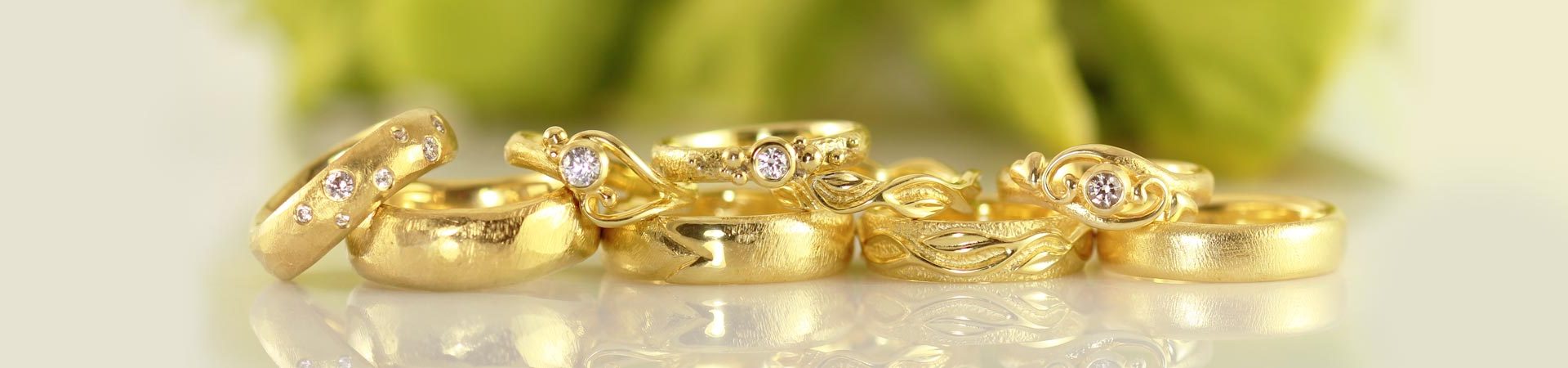

Modern jewellery, which you can buy from jewellers all over the world, is almost never made from 100% pure precious metal, because it is too soft. To strengthen the gold and also make it lighter (which makes the metal considerably cheaper), other metals have been added to it, creating an ALLOY. So how do you know what alloy a piece of jewellery is made from? You can find out by taking a closer look at your jewellery, where you should be able to find at least two hallmarks in a more or less hidden place – on the inside of a ring, for example: The first hallmark consists of a number of letters indicating the manufacturer (ours is CAS – you can see it at the top of this article) followed by a three-digit number indicating the alloy. The number indicates which alloy the jewellery is made from, and it always specifies the content of the main metal – not expressed as a percentage (divided by one hundred), but as a part per thousand (divided by one thousand).
1,000 parts per thousand = pure gold, which is also known as 24-carat. In Denmark, we primarily work with the following precious metals:
333 – 8k (333 out of 1000)
585 – 14ct (585 out of 1000)
750 – 18k (750 out of 1000)
925 sterling silver
Pt – Platinum
So what is the rest of the gold ring made of when it is hallmarked with 585, you might ask? For yellow gold, the alloying metals are silver and copper. Here is an example of the 3 typical Danish alloys, which nicely illustrate the amount of pure 24k gold in relation to the alloying metals.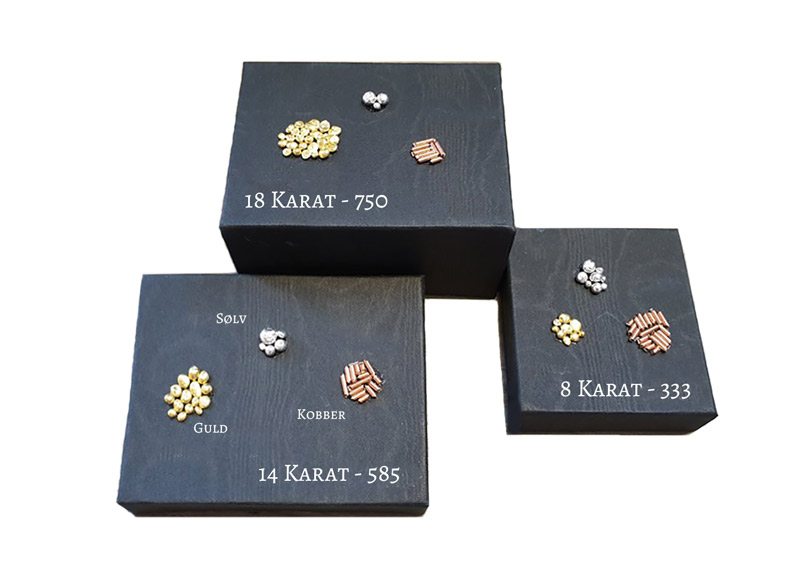
Incidentally, there are regional differences worldwide. For instance, 9 and 10 carat are also very widespread at the ”low end” (where there is approx. 1/3 gold, which means the colour is very pale), whereas in areas where people generally have darker skin (which is a very lovely background for high-carat yellow gold, which has a deep and warm yellow colour), people primarily wear gold jewellery of over 20 carat. Curiously, here 18 carat, which many of us somewhat paler Westerners regard as a high-carat alloy, is referred to as “European gold” 😉
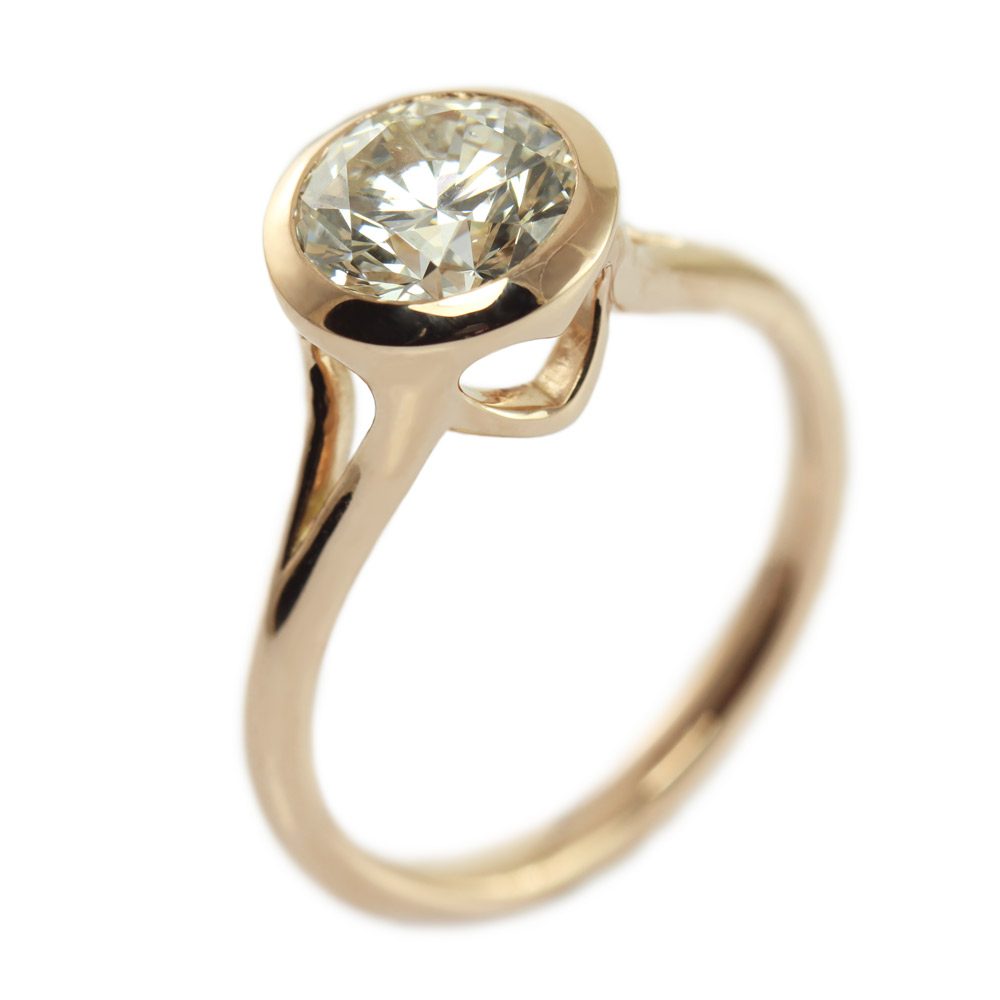
In Europe and the US, rose gold has become increasingly popular in recent years – perhaps because it’s a beautiful shade that complements our slightly paler skin? The reason why 585 rose gold is redder than 585 yellow gold is that the proportions of silver and copper mixed into the gold are different. Rose gold contains more of the red copper and less silver. Are you also a bit confused as to why we say “red gold” about yellow gold and not about rose gold?

Metals for rings – what are your options?
Let’s take a look at the most common metals used for wedding rings and other jewellery, and how these metals behave when worn as a ring every day:
Silver
Silver is reasonably priced and has a beautiful, colourless sheen when freshly polished. However, silver oxidises, which means that areas not exposed to wear and tear (which would remove the oxidation) will, over time, first turn slightly golden (resembling 8-carat gold) and then turn dark grey. Silver used in jewellery is usually sold as “sterling silver”, which means it is alloyed with 7.5% copper and is therefore hallmarked 925 (out of 1,000).
The reason for mixing copper into silver is that, although pure silver is slightly harder than pure (24-carat) gold, it is still quite soft. By adding the much harder copper, the metal becomes strong enough to be used for jewellery. However, sterling silver is not harder than alloyed gold, as the latter usually has an even higher copper content. Silver is also quite soft and malleable, which is why you’ve probably noticed that your silver rings have changed shape slightly over time – at least the more delicate ones.


Wave – a soft, heavy wave ring and a Gloomy Dragonling coiled design in partially oxidised silver
Yellow gold
– The classic material for ”important” jewellery. Whilst polished silver and other “white” metals reflect their surroundings like a mirror, gold has its own completely unique and warm colour. The surface is reasonably scratch-resistant when alloyed, and best of all: gold does not oxidise! However, this is not entirely true of 8-carat gold, as only 33% of the metal is pure gold, whilst the rest is, of course, silver and copper. If you leave an 8-carat gold ring in a drawer, it will change colour over time because the other two metals tarnish. In my workshop, we almost never use gold lower than 14k, because I believe that it is no longer ”real” gold if the actual gold content is below 50%. 8-carat gold also (for obvious reasons) has a very pale and not particularly golden colour – a fact that is often remedied in the industry by gold plating with 14- or 18-carat gold, so that it appears a warmer yellow.
But which alloy is the strongest? 14 or 18-carat gold? It depends on the alloying metals used and their proportions. Ultimately, though, it depends most on the design: if you’re going for an extremely delicate ring design of only about 1 mm, then stick to 14k, as it is slightly harder – in most other cases, you can safely choose the warmer 18k gold, which is not significantly softer than 14k.

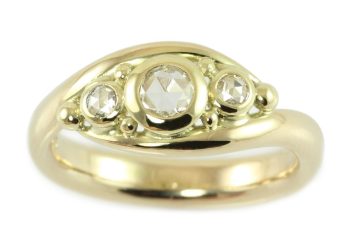
Golden Garden gold ring set with diamonds
White gold
White gold starts out as yellow, as that is, after all, the natural colour of gold. The reason it is “white” is because it is alloyed with other white metals – in Europe, mostly with silver and palladium. In the US, it is permitted to add nickel, which creates a very pure, ”white” colour. However, this is not permitted in Europe due to concerns about nickel allergies. Of course, there is a limit to how “white” you can dilute a yellow metal whilst still maintaining a 585 or even 750 carat alloy. That is why white gold actually has a delicate, warm grey colour, which can look very beautiful against fair skin. Many men prefer this metal because it has its own subtle colour.
The reason why white gold bought from your local jeweller looks like freshly polished silver is that it has been plated with rhodium. Rhodium is very hard and has a shiny, chrome-like appearance. However, as it is a coating, it will wear off over time and therefore need to be renewed approximately once a year (depending on how active you are and whether you take your jewellery off when playing sport, doing gardening, etc.).
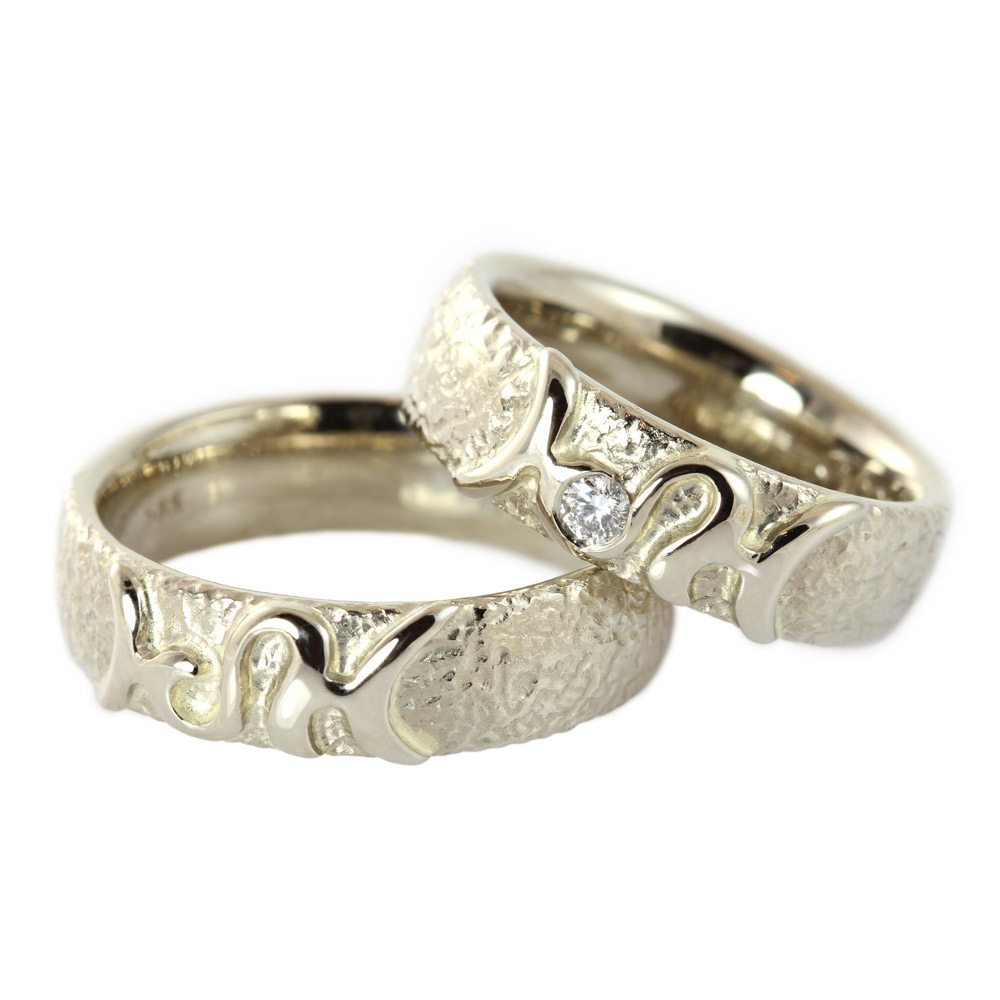

Wedding rings featuring symbols made of unalloyed white gold
and Hiding Heart (engagement) rings in rhodium-plated white gold
Platinum and palladium
These two metals are closely related and share many of the same properties: both are rare and therefore more expensive than gold. Both are “white”, that is, colourless like freshly polished silver, but unlike silver, they do not oxidise over time. Whilst platinum has long been regarded as the ”finest” of the precious metals, palladium has only been recognised as a precious metal for less than 10 years and is therefore still not very widespread here in Denmark. Both metals are harder and less malleable alloys than 14-carat gold, but they scratch much more easily. Both metals are used in a nearly pure form, with only 5% alloying. In the case of palladium, ruthenium is used, to which a small amount of copper or other components is added to facilitate casting and machining. Platinum wedding rings are alloyed with iridium, rhodium and ruthenium. In other words: the metal is very pure and therefore hypoallergenic.
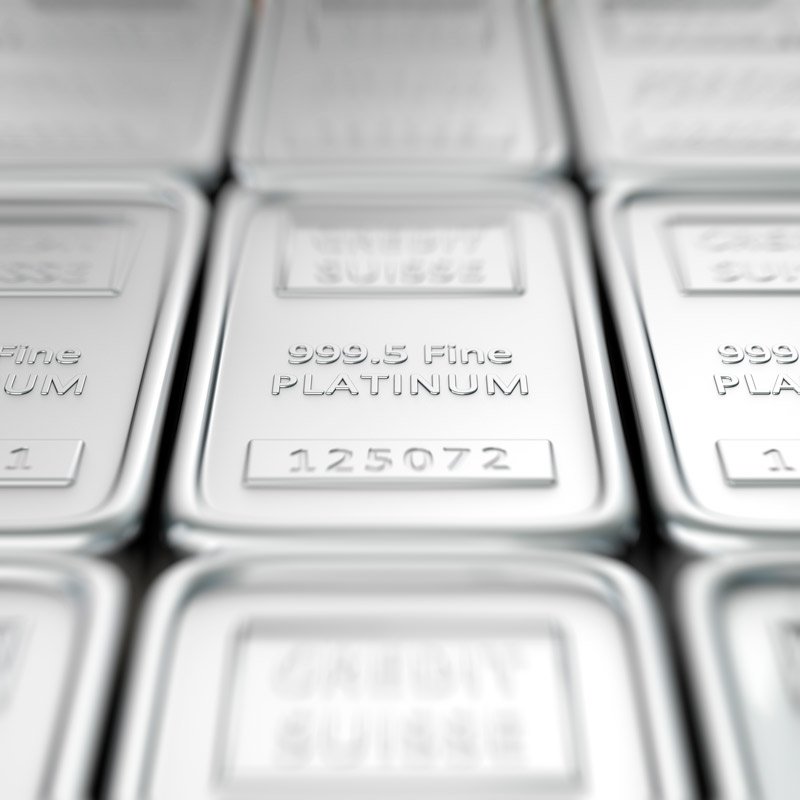
The main difference lies in the weight: platinum is much heavier than palladium and almost twice as heavy as gold! The lighter palladium is approximately 10% less prone to scratches than platinum. In other words: if you want a “white” metal without having to have it re-rhodium-plated at regular intervals, platinum or palladium are both good choices. However, a ring made from either of these metals will need professional polishing from time to time, as they are, as mentioned, more prone to scratching than (white) gold.
But beauty comes at a price: palladium, which is used to alloy white gold, has risen enormously in price in recent years because the metal is being used more and more in industry, including in electric car batteries. By contrast, the price of platinum has fallen significantly.
In practice, this means that if you have the same ring made in 14-carat white gold and platinum respectively, the platinum version will weigh considerably more. However, because the price per gram of platinum is lower than that of white gold, a ring made of platinum currently costs roughly the same as one made of white gold, whereas the same ring in palladium would be the most expensive option.

Gold plating – the cheap gold ring?
Whichever metal you choose, you can always have it plated with something else. For example, a silver ring can be plated with gold to look like a gold ring. However, as such a plating will wear off quite quickly – particularly when worn every day – you’ll notice a change within a few months. So you’ll end up with a ring that looks like the metal it was originally made from – perhaps with a bit of gold plating remaining in the nooks and crannies where it hasn’t worn off. Unless you like such a dramatic change in the appearance of your ring (which could, of course, be part of the appeal), go for the real metal from the start – you’ll always be happier with that choice in the long run.
 The real thing: A intricate solitaire gold ring with a diamond
Other interesting metals
In recent years, other alternative materials have come onto the market: titanium, tungsten, carbon and steel. Whilst all of these have become increasingly popular due to their hardness and colour – particularly amongst men – they have one major weakness: Because machining these rings requires specialised tools, which are only available in large factories, no goldsmiths with a small workshop are able to work with these materials. This also means that rings made of titanium, tungsten, steel and carbon cannot be altered in any way. In other words: if you choose a ring made from one of these materials, you must ensure that the size is correct first time round (which is not always easy – read more on this topic in my article about, how to find the right ring size) AND you can never lose or gain weight whilst wearing such a ring – because the size can never be adjusted.
A few words about diamonds set in yellow gold
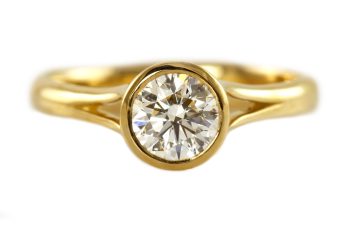
Would you like a large diamond, but can’t afford the very best quality? Then consider having it set in yellow gold. Because a diamond reflects some of the colour from the setting it’s in, you won’t be able to tell much difference between a River (D) and a Wesselton (H) diamond! Incidentally – if you’re buying what I usually call a “significant everyday piece of jewellery”, such as an engagement ring or wedding rings, the gemstone to be set in the ring must also be durable. Read more and/or watch a video about gemstone durability here.
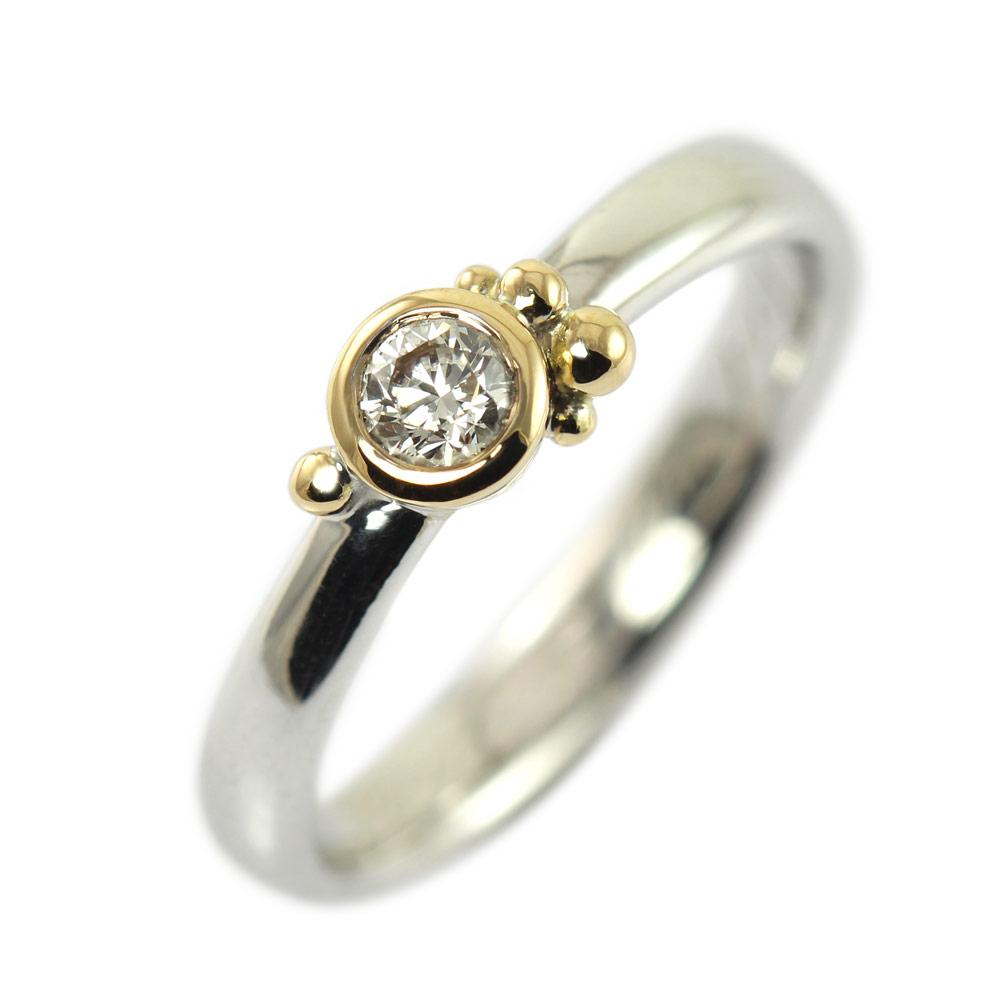
Solo – a unique solitaire, where the yellow gold in the setting creates a beautiful contrast to the cool (rhodium-plated) white gold.
Are you still unsure which material to choose? At least you’re thinking about it on a more sophisticated level now 😉 See a wide range of handmade rings crafted from various precious metals here.
Blog categories