




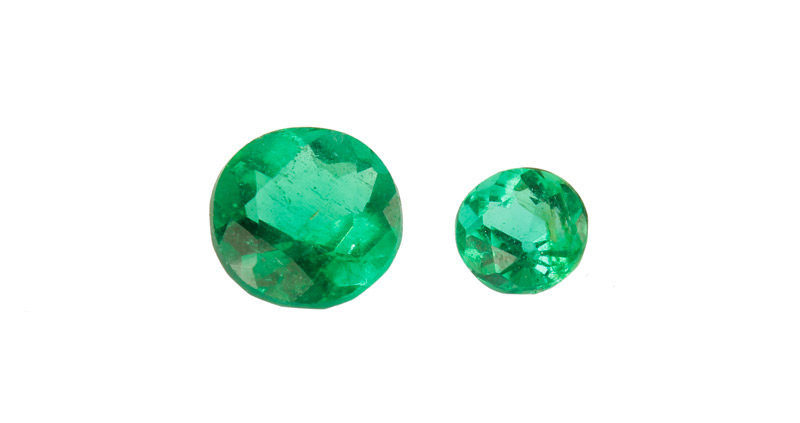
The inclusions give each emerald its individual character, although it is possible to find emeralds that appear clear to the naked eye. However, these stones are a rarity, therefore difficult to obtain and very, VERY expensive! Even the large, intensely green emeralds found in royal jewels most often have obvious inclusions.
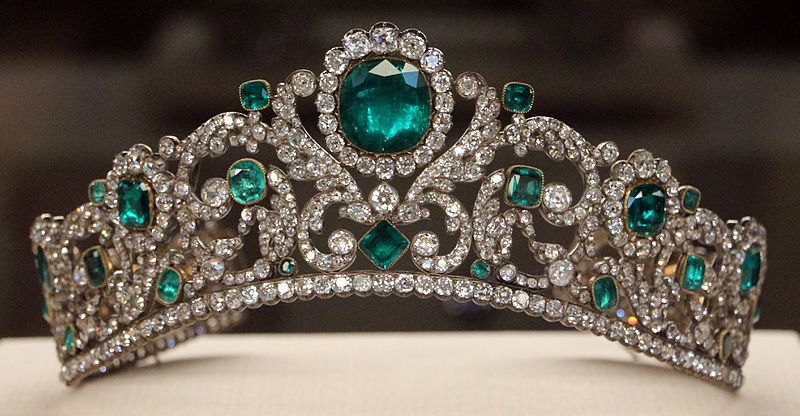
But inclusions are something we've learned to love, because the colour is beautiful; from the most delicious mint green to the most intense emerald green – emeralds are a feast for the eyes! And then there's actually a neat trick to this ”garden”: because each emerald has its own unique, personal character, a good close-up of the stone can help identify it even after it has been removed from its setting (if, for example, the jewellery has been stolen and taken apart). In other words, the equivalent of a fingerprint!
Did you know:
Emeralds are 20 times rarer
End the diamonds!
Inclusions are located inside the stone and most often also break its surface, which means that an emerald rarely has a completely uniform, smooth surface when examined closely. Since colour is what is most focused on with emeralds, it is not something that is particularly noticed when looking at the jewellery as such. However, if the light falls at the right angle, one will be able to see lines etc. on the surface of most emeralds. Almost all emeralds are treated with colourless oil to reduce how much these inclusions show on the stone's surface. Therefore, an emerald should never be cleaned in an ultrasonic cleaner or left in soapy water, as this will remove the oil and then the lines on the surface will be more clearly visible! Stones of poor quality are also sometimes stabilised with epoxy, which is a rather complicated process involving pressure and heat.
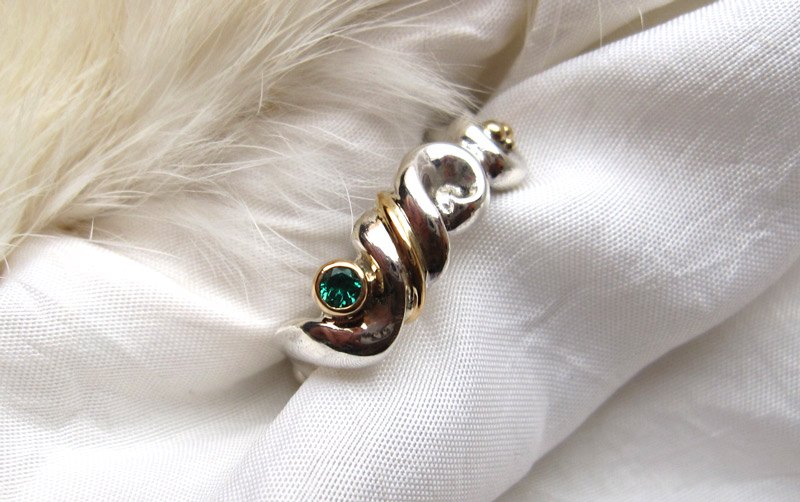
White gold and yellow gold wave ring with synthetic emerald
If you want a clean emerald with a polished surface, without sacrificing your firstborn, there is an alternative in lab-created emeralds – what the industry calls ”synthetic emeralds,” which often have significantly fewer inclusions. One could argue that synthetic emeralds are better for the environment, although this discussion is more nuanced than that.Read more about gemstones in the article here).
Don't propose with an emerald ring!
Emeralds do not belong in “important everyday rings” such as engagement or wedding rings. The simple reason is that, despite the emerald actually ranking quite high on the Mohs scale (which ranks minerals by hardness – Read more here), its uniqueness with all the inclusions, makes it ”brittle” and liable to break from a relatively small blow if hit correctly (or incorrectly, of course). An engagement ring should ideally last a lifetime, which is unlikely for an emerald with daily use. Consider the unfortunate symbolism of a stone in an engagement ring breaking even before the wedding. It's unbearable! If you want a green stone in your engagement ring, you could consider a green sapphire or diamond instead.
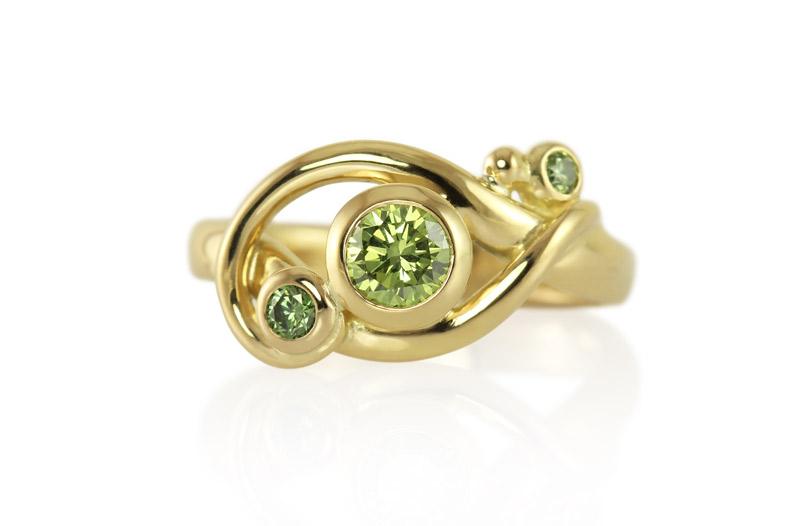
Unique gold ring with green diamonds. Part of a bridal set – Read more here
For reasons as outlined above, emeralds are so notorious/feared in the industry that many goldsmiths simply refuse to work with them and, in any event, require COMPLETE and undisturbed peace when setting these gemstones. At Castens, we work with emeralds, but not drop-shaped or square ones with sharp corners, because the risk of chipping a corner off during the setting process is simply too great.
The beautiful emeralds are, first and foremost, ideal for earrings or necklaces (or tiaras, for that matter 😉). Who can forget, for example, that iconic red carpet picture of Angelina Jolie wearing a set of absolutely wonderful emerald drops at an Oscars ceremony? These stones (115 carats in total) were exceptionally large, strong in colour, and relatively clean, and therefore the earrings cost the tidy sum of 2.5 million dollars in 2009.

Significantly smaller stones can be obtained for a significantly lower price, but they are still very difficult to find in a quality where both the colour is ideal and there are no visible inclusions. Because, as one of my suppliers dryly noted: Once Cartier, Graff and all the other big players have taken their pick, the rest of us have to make do with what's left. This applies, incidentally, to all stones that belong to the rarer category.
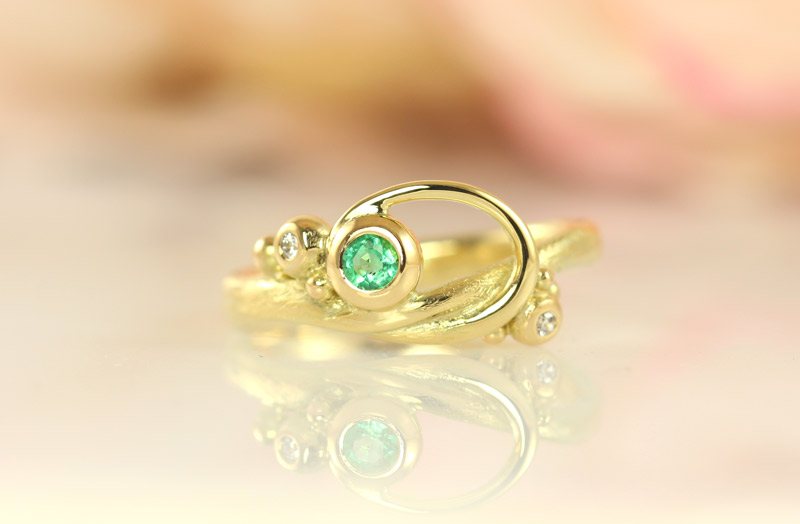
The exception to the rule: Although we prefer to avoid setting emeralds in rings, we currently have a single, unique ring with a small, 3 mm emerald. And it truly is lovely!
The preciousness of emeralds doesn't preclude rings entirely: you could certainly go all out with a wonderful emerald in a beautiful cocktail ring, which you only wear on occasion. Or how about small colourful accents in the form of ”cheerleaders” as I call them, the small supporting stones that more or less symmetrically surround a centre stone?
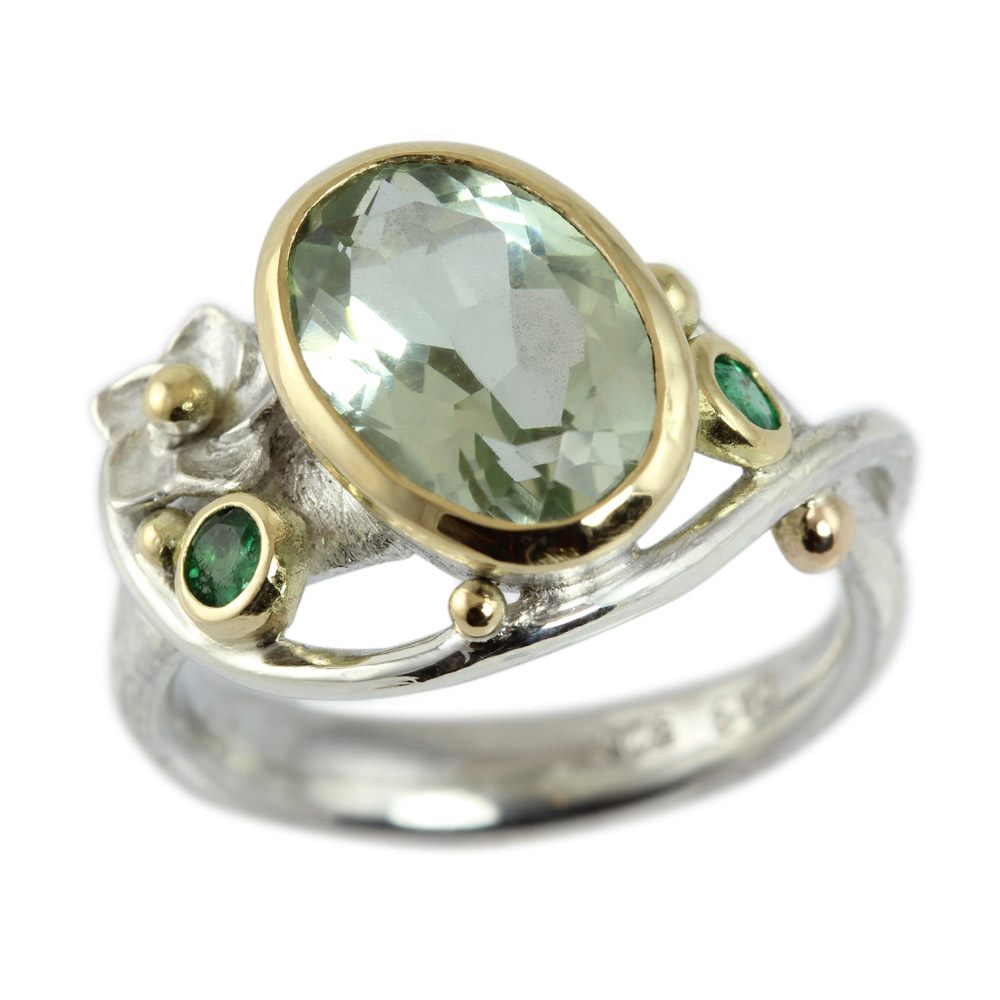
The small emeralds here originate from my client's grandparents, where they used to be set in an earring that she inherited. The emeralds from the single earring were given new life in this ring with a light green prasiolite as the centre stone.
Read more about emeralds at GIA here
The small loose emeralds at the top of the article are for sale, by the way.
The small one measures 3.2 mm, weighs 0.14 ct and costs 2,125 kr.
The large one measures 4.6 mm, weighs 0.35ct and costs 3,500 kr.
Write an email to design@castens.com or call us on 32 200 444 to reserve them
Blog categories