

”What is a chasuble?” you might ask. It is the often quite brightly coloured robe that the priest wears over their ordinary vestments for high mass. Churches often have several chasubles, which are coloured to match the season or the liturgical calendar.

I come from Haderslev in Southern Jutland, where the Queen in my childhood had designed four different Chasubles with accompanying altar cloths for Haderslev Cathedral. They are permanently displayed in the crypt beneath the altar and I have actually often stood and admired them. Therefore, there is also a certain pride in now being able to say ”The Queen and I – suppliers to the Danish National Church” – ahem 😉

The chasuble that was to be created differed from the usual model, which is closed – fundamentally it consists of a piece of fabric with a hole in it, which is pulled over the head. At Sct. Lukas, there is a tradition of having an open chasuble, which is then fastened with a clasp. As the current priest is female, the clasp was to be placed on the chest (rather than across the stomach) for the chasuble to fit well, and therefore it was to be a little smaller than the old one, just as the chasuble itself was also to be without “sleeves”.

Lent and advent belong to the time when purple is the dominant colour according to the liturgical calendar, and the new chasuble should therefore be created in violet damask with floral embroidery inspired by the church's decoration. When the clasp was to be designed, we chose the same approach to arrive at a motif:
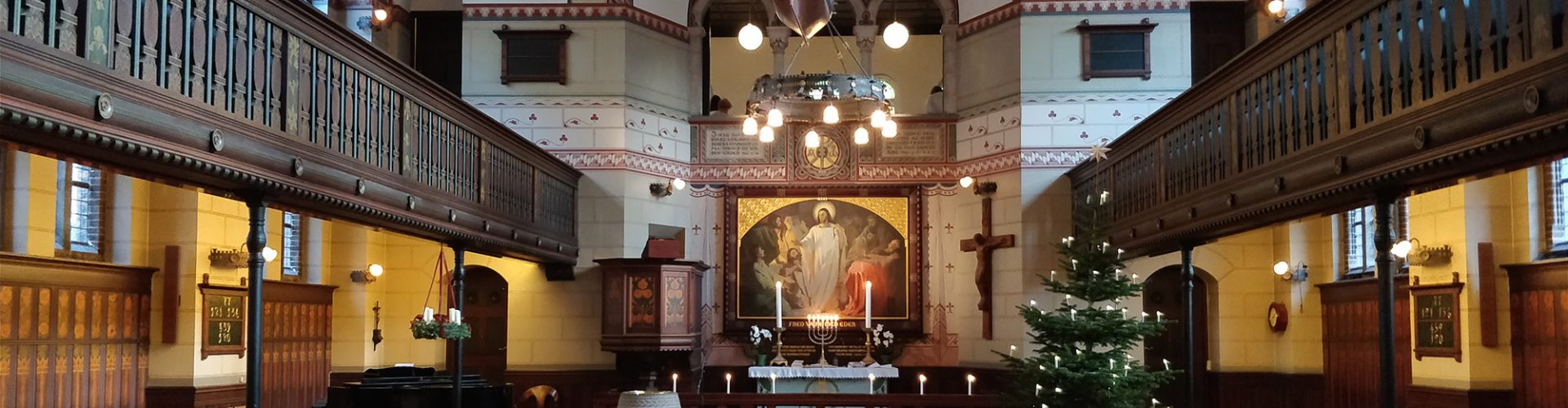
St. Luke's is a charmingneo-Gothic church from 1826, where many generations' styles come together in an appealing whole. This also means there are many fine details that can be used for inspiration. However, as each half of the arch functions best if they form a closed whole, it wasn't just any motif that could be used. The choice fell on a set of acanthus leaves, which discreetly support the painting that forms the altarpiece itself.

The acanthus leaf is a well-known design motif, first encountered in the Corinthian period of ancient Greece (just look at the finely decorated tops of columns for an interior view).

They re-emerge in the Middle Ages, for example in the very beautiful and colourful illuminations created by monks in dark monasteries. Therefore, it was probably also an obvious choice to use this motif when decorating the newly built St. Luke's Church in Frederiksberg at a time when there was a fascination with the romantic High Middle Ages, among other things.

The beauty of acanthus leaves is that they (much like ferns) shoot up from the ground as little knobs that then slowly unfurl into upright stems. This somewhat inward-looking, turgid form holds so much power, poised to unfold into something fantastic – just like an embryo or a young child in its mother's womb, which similarly exists in a curled form before straightening out completely at birth and taking its first breath.
As the clasp was to be used for the chasuble created for use during High Masses focused on more introspective and serious activities, where, among other things, penance and remorse are the spiritual task of the period, it also made sense to create a clasp where the motif closes in on itself. After this introspective period, humanity will unfold and be ready to receive life's gift. The violet period is indeed often followed in the church year by the green period, where growth, spring and hope are on the agenda or, as is the case on the day when a festive service marks the new chasuble being put into use, the 2nd Sunday of Advent. And no full bloom without the sprout, which has done its bit beforehand!

This is how the buckle was built
At the design meeting in my shop, we discussed the various options and quite quickly settled on acanthus leaves as the motif. After the meeting, I drew up the idea with three different suggestions for how the fastening mechanism should work.

The most beautiful, but also the most demanding, version was where a part of one leaf reached over the other in a hook. To make sure it would work, I made a test version out of cardboard.

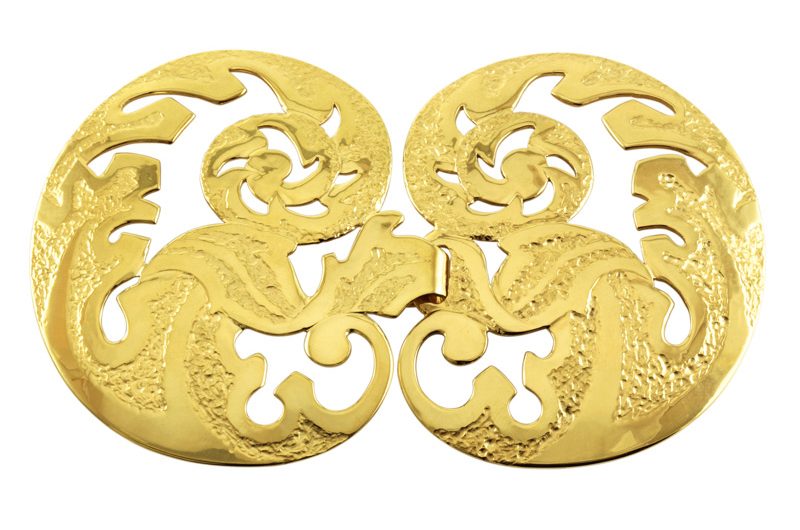
Thereupon I cut the two halves out of a brass plate and domed them with a round wooden hammer, after which they were carefully engraved, so that rough structures contrasted with the polished ones.


In this manner, I emulated the subtle difference present in the original painted motif, where green colours, rather than structures, shaped the design. A small part of the leaf on one half reached out to the other, binding them together into a twin form that closed in on itself, seeking support from each other.


Small, discreet loops were soldered onto the back of the clasp so that it could be securely attached to the chasuble. Before the clasp was gilded with 18ct gold.


The chasuble is sewn by ladies' tailor Katherine Ines Pitarch, who owns Dress by Ines. She has been at least as focused on getting the details of the church's floral decorations right as I was – and she did a fantastic job with that challenge!
It has been a pleasure to create something for a goldsmith as unusual as a clasp – and for such a venerable institution as the Church of Denmark. I approached the task with a certain pride and humility at having been chosen to build something entirely different from the Common handmade jewellery, which I create daily in my workshop. Not all my tasks are equally memorable, but this one will certainly not be forgotten!

Bettina Christiansen in full high mass vestments
Blog categories