Tel +45 32 20 04 44
design@castens.com

Holbergsgade 19a
1057 Copenhagen K, Denmark

During the artistic design process, we work closely with you and strive to merge your vision with refined craftsmanship to create a new piece of jewellery with a unique character.
We take on a wide range of handmade jewellery projects, so whether you need rings for parties or everyday, engagement rings, bridal sets, wedding rings, necklaces, bracelets, earrings or other adventurous jewellery, we are ready to wield the tools and create jewellery for the most important moments in your life.
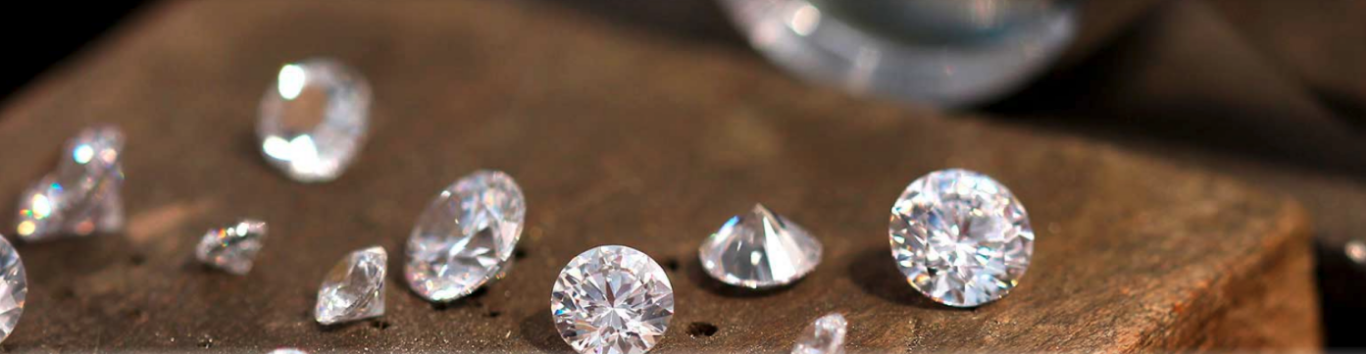
What kind of diamond should I choose?
You may have already stood at the jeweller's, held a ring between your fingers, felt the weight of the metal and imagined it on your hand – forever. The design is chosen, the metal is in place. And when the question of the stone comes up, most people answer without hesitation: a diamond.
But then comes the next question. Should it be natural or synthetic (also known as "lab grown", "laboratory created", or "man-made")? And suddenly, the choice isn't quite so simple anymore. Because what's the real difference – and which diamond feels right for you?
At Castens, we believe that jewellery is at its most beautiful when the choices behind it are made with calm, knowledge, and a good gut feeling. That's why we've gathered the most important things you should know about natural and synthetic diamonds – not to push you in any particular direction, but to give you an informed basis to choose from.
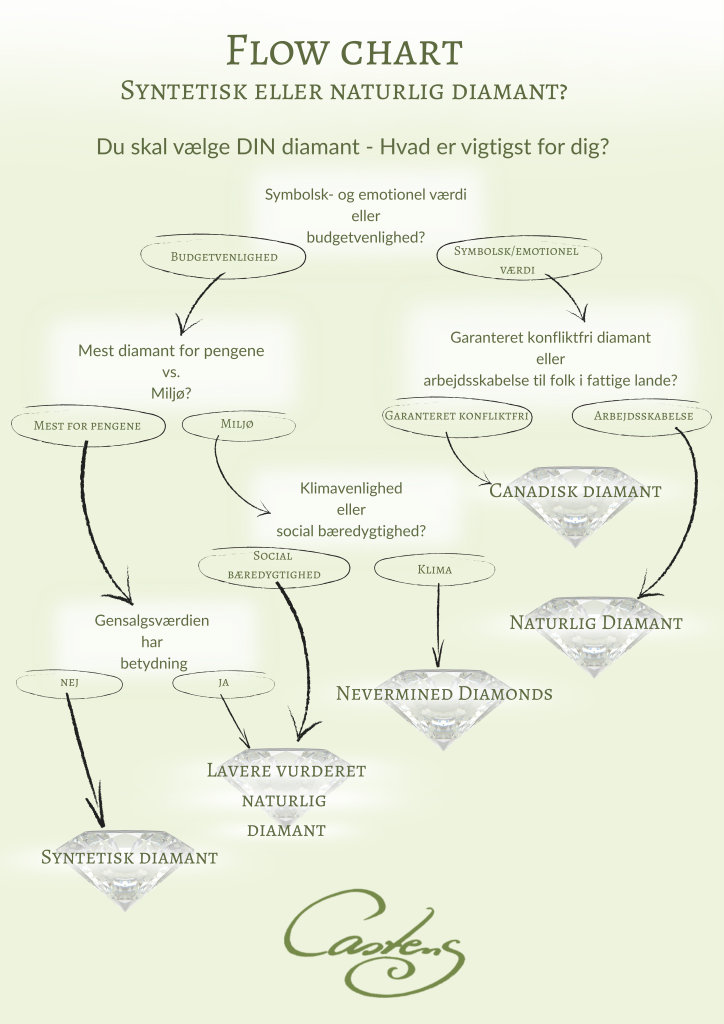
Do you need an extra tool to choose precisely YOUR diamond? Then test yourself by following this flowchart.
Diamond is the hardest mineral on Earth. Its fire, clarity and ability to break light into rainbow colours are undisputed. For centuries, the precious stone has been known, loved and shrouded in mystery across cultures. It was believed to possess magical powers, and he who wore a diamond exuded both power and status.
This is why the diamond has become a symbol of eternal love – particularly in wedding rings, and today it is the preferred stone in both engagement and wedding rings. Because it can withstand everyday wear and tear, life's movements, and the passage of time without losing its sparkle.

A natural diamond is created deep inside the Earth, 150–200 km below the surface, several billion years ago. Carbon, under extreme pressure and heat – approximately 900–1300 °C and 45,000–60,000 atmospheres of pressure – has slowly crystallised into diamond. A process believed to have taken up to a billion years.
The immense pressure forces the carbon atoms together in a structurally perfect, cubic system. It is precisely this almost poetic perfection at an atomic level that gives the diamond its legendary hardness. And that is why we can still wear a diamond for generations without it losing its lustre.
It's quite incredible to think that something so old and slowly created can today sit on a finger and be a part of a human life!

Synthetic diamonds have the same chemical composition as natural diamonds – pure carbon – but their history is different. They are not created by the Earth, but rather efficiently by humans, technology, and machines.
The first synthetic diamond was produced in 1954, but it wasn't until the 1990s that the quality reached a level where they could be used in jewellery – though still often with a slightly yellowish tint.
The major breakthrough came around 2015, when the HPHT method made it possible to produce synthetic diamonds in much larger sizes. In 2022, the company Ethereal Green Diamond succeeded in producing a synthetic diamond of a full 30.18 ct in H VS2 quality.
Today, synthetic diamonds are primarily produced via two methods:
CVD (Chemical Vapour Deposition)
A small diamond seed, consisting of a thin slice of an HTHP-created diamond, is placed in a chamber with carbon-rich gases such as methane and hydrogen. At temperatures of approximately 900–1200 °C, the gases are activated with microwaves, and the carbon atoms deposit layer by layer onto the seed and crystallise, causing the diamond seed to grow into a diamond. A bit like 3D printing. Over 3–4 weeks, the diamond grows.
HPHT (High Pressure High Temperature)
In this manufacturing method, high temperatures and high pressures are used to achieve the same conditions as those found in the Earth when diamonds are produced naturally over billions of years. Here, the method also begins with a ”diamond seed,” made of graphite, which is placed in a large machine with a metal solvent. It is then placed in a press with a molten flux of metals such as iron, nickel, or cobalt. Here, in this press, it is crushed under extreme pressure and heat, around 1300-1600°C. The extreme pressure required, according to the Gemological Institute of America, is roughly equivalent to the pressure a passenger plane would exert if balanced on a person's fingertip. These conditions cause the carbon to migrate through the flux and onto the cooler diamond seed, where it crystallises over days to weeks, forming a diamond.
Both methods require large amounts of energy, but not nearly as much labour as natural ones.

To the naked eye: No.
With the knowledge and the right equipment: Yes.
To better understand the differences, we spoke with Casten’s diamond supplier Ole Rebner, founder of Pure Diamonds and the only Danish member of the World Federation of Diamond Bourses. He explains that the differences lie in nitrogen content, growth patterns, and UV fluorescence.
According to Ole, natural diamonds often have complex, irregular growth patterns and uneven blue UV fluorescence. HPHT diamonds have more cubic patterns and blue-green fluorescence, while CVD diamonds typically have layered growth patterns and an orange fluorescence. Nitrogen occurs in clusters in natural diamonds, individually in HPHT, and is almost absent in CVD.
So even though you can neither see growth patterns, UV fluorescence, nor nitrogen by looking at a polished diamond with the naked eye, professional equipment and technologies can determine whether a diamond is naturally created or synthetically produced.

Natural diamonds have historically been associated with ethical issues, which still weigh on many people's minds.
The word "blood diamonds" can make most people stop and think twice when it comes to buying a diamond – even today. The concept of blood diamonds – also known as conflict diamonds – covers diamonds that are extracted from conflict zones and sold with the aim of financing war, rebellion, or other armed conflicts. They are undeniably associated with violence, death, and human rights abuses. This issue has had a significant impact on how the diamond industry is regulated today.
The international diamond market is subject to extensive controls and legislation aimed at preventing the trade in conflict diamonds. A key tool in this work is the Kimberley Process, which was introduced in 2003. The Kimberley Process is an international certification scheme used today by 86 countries. Member countries commit to implementing legislation and control mechanisms that ensure traceability and a documented, ethical supply chain for rough diamonds.
Today, the member countries of the Kimberley Process account for around 99.8 % of global rough diamond production and, according to the World Diamond Council, the KP prevents 99 % of all conflict diamonds from entering the market. Although no system is entirely flawless, these international initiatives have played a significant role in increasing transparency and accountability within the diamond industry.

Despite all these initiatives, some may continue to be concerned that the purchase of a natural diamond could be indirectly linked to conflict diamonds. In that case, Canadian diamonds can be a relevant alternative. These diamonds are mined exclusively from Canadian mines and are, of course, also covered by the Kimberley Process.
Canadian diamonds are also distinguished by the fact that each stone above a certain size is supplied with a unique identification number, laser-engraved on the diamond's girdle, which provides extra traceability. Production is subject to strict Canadian requirements for both environmental considerations and working conditions, including a focus on safety, fair wages, and responsible operation.
For those who want a natural diamond with a high degree of documentation, traceability, and regulation, Canadian diamonds can therefore be an obvious choice. However, it is worth noting that these conditions are typically reflected in the price, and Canadian diamonds are therefore often at the higher end of the price scale compared to other natural diamonds.

When discussing sustainability, climate and environmental impact, as well as ethics in relation to natural and synthetic diamonds, there isn't a single clear-cut answer as to which solution is ”best.” The area is complex and depends on many factors.
Natural diamonds extracted through mining, which inevitably affects nature and the environment and requires resources such as water, fuel and electricity – depending on how the mining is conducted. It can therefore lead to water and air pollution, cause soil erosion in the area, result in deforestation, and emit CO2, not least because of the machinery used. This sounds severe, which is why initiatives are being worked on to reduce CO2 emissions, increase the use of renewable energy, and protect biodiversity. Furthermore, once a diamond mine has been depleted, today's mine owners are obliged to restore the nature in the area.
The natural diamond industry is subject to international standards, legislation and controls, including the Kimberley Process. It also simultaneously creates many jobs and economic development in some of the world's poorest regions.
Synthetic diamonds The latter is often spoken of as a more sustainable alternative, but this depends heavily on how they are produced. The factories consume raw materials such as graphite, nickel and cobalt, as well as gases like methane and hydrogen, all of which are extracted through mining. Furthermore, it requires large amounts of energy, which generally comes from the countries' public energy grids (particularly China, followed by India) – where the energy still primarily comes from fossil fuels. So, in practice, large coal mines are dug with heavy machinery and the energy is extracted by burning coal, which naturally all emits a lot of CO2. It is this energy that is used in diamond production – which in turn does not emit as much CO2 itself as the excavation of natural diamonds does.
According to one of the major jewellery manufacturers in the industry, which only uses synthetic diamonds, it would save more than 6 million tonnes of CO2 per year if the mining of the world's natural rough diamonds had as low a CO2 footprint as their synthetic diamonds. But does that include indirect CO2 consumption?
So what is best for the environment and people?
It is very difficult to fathom, because it is not possible to find independent documentation. It is ”common knowledge” that synthetic diamonds are better for the environment, but as mentioned, it depends greatly on where the energy comes from.
Ole Rebner also doesn't believe you can definitively say one type is more ethical than the other. However, he points out that there are currently no guarantees that synthetic diamonds are NOT sourced from conflict areas, as the Kimberley Process prevents for natural diamonds. We are still waiting for that.
The choice between natural and synthetic diamonds, therefore, is not about a simple either-or, but about understanding the differences and making a choice that feels right for the individual.

At Castens, we have so far identified one producer of synthetic diamonds that is truly able to document its sustainable initiatives – namely Nevermined Diamonds. It is a German-based company that produces synthetic diamonds in Essen exclusively using renewable energy sources such as solar, wind, and hydropower. The company has a clear focus on climate and sustainability in both production and operation and, incidentally, feeds excess heat from production back into the local district heating network.
Nevermined Diamonds are therefore a relevant choice if you want a synthetic diamond with documented European production and the use of renewable energy. However, this means that these diamonds are typically priced higher than mass-produced synthetic diamonds created outside of Europe – though still considerably lower than natural diamonds.

Natural diamonds are the most expensive option – but also the one with the most stable prices. Over the last 35 years, prices have risen by an average of around 3 % per year, not least because it is becoming more expensive to mine diamonds as the ”easy” ones have been dug up. After all, the only natural diamonds available today are those that were formed millions of years ago.
Synthetic diamonds, on the other hand, can be produced in infinite quantities, which is why their price has fallen as production has increased. Unlike natural diamonds, they are priced according to production costs and retail mark-ups. Increasing competition amongst producers has now driven down the price of synthetic diamonds to between 10 and 20 % of the price at which a natural diamond is traded.
For this reason, there is effectively no resale value for synthetic diamonds, whereas natural ones, according to Ole Rebner, more or less hold their resale value.
In short: If you want the most diamond for your money right here, right now, a synthetic is the obvious choice. If you want history, symbolism, and value that should extend into the future, the arrow points towards the natural diamond.

Here is a consolidated overview of the advantages and disadvantages of each type of diamond.
In short:
The most important thing is that the choice feels right for you.

Didn't find what you were looking for?
Get your own custom made jewellery
Have a piece of jewellery created just the way you want it. At Castens, we create handmade jewellery in our workshop for those who appreciate unique designs that have a special meaning to you.